Micro/nanobubble-oxygenated drip irrigation under excessive irrigation conditions improves tomato yield in mildly saline soils by regulating rhizosphere and root endophytic bacterial communities
https://www.sciencedirect.com/science/article/abs/pii/S0167198725001898
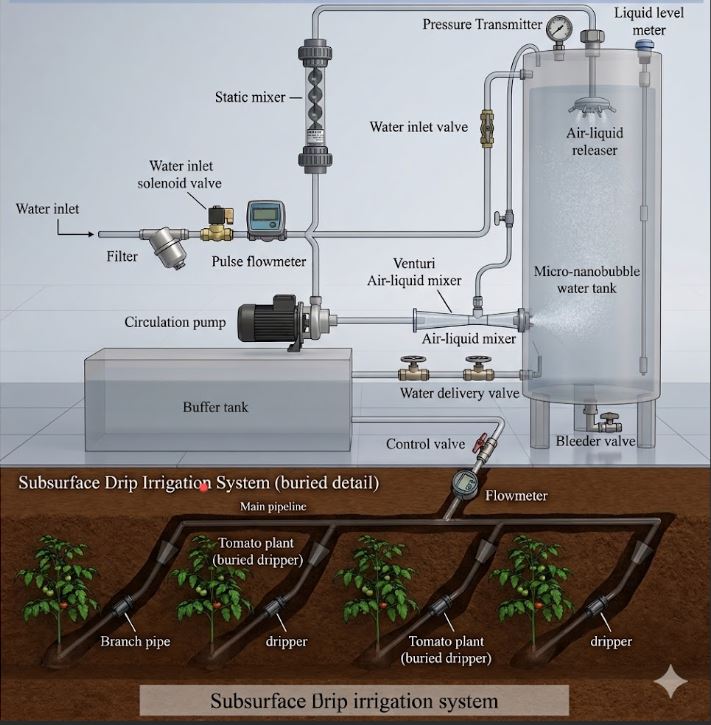
The purpose of this study was to explore the microecological mechanism
by which micro/nanobubble-oxygenated drip irrigation promotes the
growth of crops in saline soil under excessive quantities of irrigation water.
This study focused on investigating the response of root bacterial communities
to the cumulative effects of excessive irrigation water at different dissolved
oxygen (DO) concentrations and analyzing the changes in the root–soil
interdomain bacterial community network and their relationships with the
soil microenvironment in the root zone and tomato yield. Compared
with the noncultivated treatment in saline soil (CK), the high-DO concentration
treatment (30 mg·L−1, i.e., DO30) led to a 94.51 % reduction in the soil electrical
conductivity (EC) in the root zone, and the Shannon index of the rhizosphere soil
bacterial communities increased by 3.94 %. DO30 significantly increased the relative
abundance of Bdellovibrionota, which are nitrate metabolism-related root endophytic
bacteria, and Sphingomonas, which are root endophytic bacteria with a nitrogen fixation
function. Additionally, the average root diameter and root volume of the tomato
root system increased by 51.93 % and 151.36 %, respectively, compared with those
under the low-oxygen (5 mg·L−1, i.e., DO5) treatment. These changes enhanced
the influence of root–soil bacterial communities on tomato growth; therefore,
the tomato yield increased by 87.20 % and 13.22 % compared with that under
the DO5 and moderate-DO concentration (15 mg·L−1, i.e., DO15) treatments,
respectively. Compared with that under the CK treatment, the Shannon index
of the rhizosphere soil bacterial community under the DO15 treatment increased
by 4.34 %, and the relative abundances of the beneficial root endophytic bacteria
Nitrospirota, Myxococcota, Acidobacteriota, and Gemmatimonadota significantly
increased. However, the effects on average root diameter, root volume, and soil
EC reduction in the root zone were inferior to those under DO30, limiting
nutrient uptake by the roots. As a result, the yield was lower than that under
DO30 but 36.82 % higher than that under DO5. Therefore, when micro/nanobubble-oxygenated
drip irrigation under excessive irrigation conditions was used to promote tomato
production in saline soils, DO30 was preferentially recommended, followed by DO15.