Ozone Nanobubble Treatment Improves the Bacterial Water Quality and Early Rearing Of Oncorhynchus Mykiss in Pond-Based Fish Hatchery
https://papers.ssrn.com/sol3/papers.cfm?abstract_id=4937541
This study investigates the effectiveness of ozone nanobubble
technology (O3NB) as a water treatment for rainbow trout
(Oncorhynchus mykiss) early rearing in a pond-based freshwater
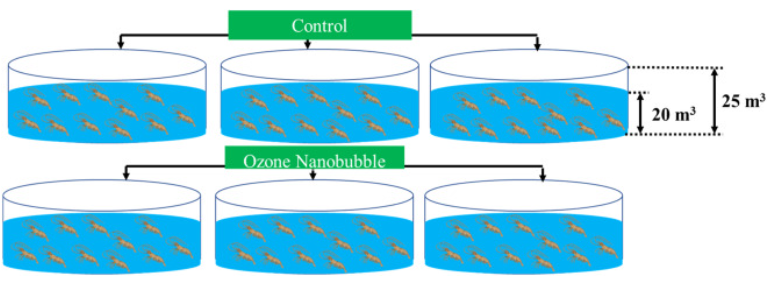
fish hatchery.The experiment assessing the interplay of four O3NB
water treatments (none, low, moderate, and high; marked 1-4) and
two rearing techniques (without/with the removal of unfertilised eggs
and dead individuals, titled N and S, respectively) was conducted.
Combining these techniques and O3NB treatments, eight groups
(1-4N and 1-4S) were formed and tested in four repetitions in the early
stages (embryos and larvae) of O. mykiss.In this study, the bacterial
quality of rearing water was assessed at the phylum, family, and genus
levels, revealing a negative correlation between O3NB water treatments
and the count of microorganisms (assessed by four diversity indices –
ACE, OTU, Shannon's, and Simpson's). Although the alpha diversity of
microorganisms in water was not statistically different with different O3NB
treatments, the diversity of microorganisms assessed at the genus level
was markedly lowered (1.4–1.9 times) in all the O3NB treatments compared
to the control. The predominant genera were mainly Moheibacter (12.1 %),
Flavobacterium (11.8 %), and Limnohabitans (10.1 %), while all other genera
were presented in lower amounts (<10 %). Furthermore, in this study, the
O. mykiss performance was significantly influenced by the two rearing
techniques and the tested O3NB water treatments (low-high). They markedly
affected all the observed parameters (hatching, growth, yolk-sac resorption,
and survival rate), which were noticeably decreased in the N- compared to the
S-technique. Moreover, there was a dose-dependent effect of O3NB concentrations
on these parameters, which were negatively affected, especially by the high O3NB
treatment, while the low positively affected O. mykiss rearing.Overall, the low O3NB
water treatment and the periodic removal of unfertilised eggs and dead individuals
may be helpful for pond hatchery practice, while the high O3NB treatment had adverse effects.