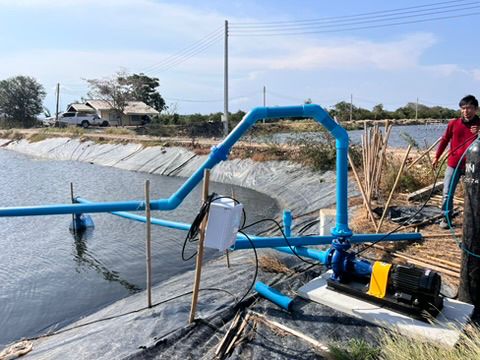
Pure Oxygen Nanobubbles dealing with low dissolved oxygen level in soil pond with little water exchange.
How oxygen nanobubbles can help
1. Increase dissolved oxygen
* Oxygen nanobubbles have a very large gas–liquid interfacial area.
* They can transfer oxygen into the pond water efficiently and maintain higher DO, particularly during periods when conventional aeration struggles.
* This is especially important at night and early morning, when photosynthesis stops and DO can reach its lowest level.
2. Improve oxygen availability throughout the pond
* Nanobubbles can remain suspended in water much longer than conventional large bubbles.
* This can help distribute oxygen below the surface and into areas where oxygen depletion occurs.
* Better circulation combined with nanobubble injection can reduce localized low-DO zones near the pond bottom.
3. Improve fish growth indirectly
When tilapia experience chronic low DO, they generally reduce feeding activity and energy utilization. Raising DO to a more favorable level can help:
*Higher DO → better feeding → better metabolism → improved feed utilization → faster growth.
Nanobubbles themselves do not directly make tilapia grow faster; the benefit comes primarily from improving the pond's oxygen environment.
4. Help with organic matter accumulation
* In a low-exchange soil pond, uneaten feed, feces and other organic matter accumulate.
* Oxygen availability near the bottom can support aerobic microbial activity that helps break down organic material.
* This can potentially reduce the development of highly reduced/anaerobic zones in the sediment.
5. Reduce the risk of early-morning oxygen crashes
A typical pattern in a poorly aerated pond is:
*Afternoon: DO relatively high → night: DO declines → early morning: minimum DO → fish become stressed.
An oxygen nanobubble system operated during the night and early morning can help flatten this DO cycle.
Important point for soil ponds
O₂ concentrator / oxygen source → nanobubble generator → pond circulation
combined with some mechanical circulation/aeration such as paddle wheels
The objective should be to measure DO at several locations and depths, especially just before sunrise. If the bottom DO is very low while surface DO appears acceptable, improving vertical circulation + oxygen injection becomes particularly important.
Practical target
For tilapia, maintaining DO comfortably above approximately 4–5 mg/L is generally a good operational objective, while avoiding unnecessarily high oxygen consumption. The most important measurement is often the minimum DO around dawn, rather than the afternoon value.
If the pond has low water exchange + high organic loading + slow tilapia growth, Oxygen nanobubbles are considered as part of a broader strategy:
*Oxygen nanobubbles + water circulation + bottom organic-matter management + appropriate feeding
This combination is likely to be much more effective than simply adding more oxygen to the pond.