https://www.sciencedirect.com/science/article/abs/pii/S2213343725017142
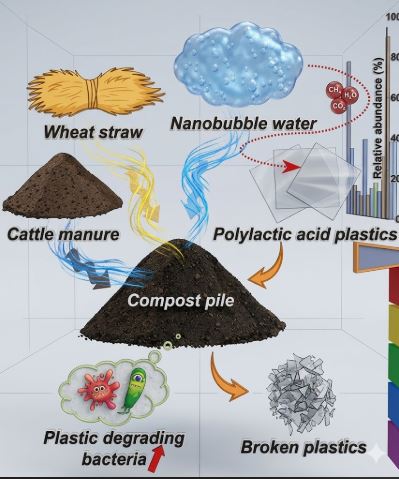
Nanobubble water enriched the Pseudomonadota (10d).
Nanobubble water promoted the hydrolysis of C═O in plastics.
Nanobubble water reduced the number average molecular weight of plastics
Biodegradable plastics (BPs) degrade slowly in the natural environment,
which is potentially threatening to human health and ecosystem security.
Among these, polylactic acid plastics (PLA-Ps) are the most widely used BPs.
This study investigated the promotion of PLA-Ps degradation during aerobic
composting of cattle manure and wheat straw by the addition of N2 or CO2
nanobubble water (NBW). NBW increased the peak temperature by 1.0–1.8℃,
advanced the peak temperature by 3 days, and increased urease activity on day
10 and day 57 by 14.5 %–80.6 % and 37.6 %–158.1 %. The contents of total nitrogen
and total phosphorus increased by 6.2 %–8.6 % and 7.2 %–7.6 %, respectively,
which enhanced the fertilizer efficiency of compost products. The ·OH produced
by NBW attacks the ester bonds in PLA-Ps and increases the relative abundance
of Pseudomonadota, which promotes the hydrolysis of C═O, resulting in more
pronounced erosion and cracking on plastic surfaces. The thermal stability of the
PLA-Ps was improved, while their structural stability was compromised. Meanwhile,
NBW decreased the number-average molecular weight of PLA-Ps, broadening the
molecular weight distribution. These findings suggest that the addition of NBW to the
composting process of cattle manure and wheat straw can enhance the degradation
of PLA-Ps and improve the composting effect.