Electric Field-Based Ozone Nanobubbles in Tandem with Reduced Ultraviolet Light Exposure for Water Purification and Treatment: Aquaculture and Beyond
https://www.mdpi.com/2076-3298/11/12/292?
This study investigated the impact of electric field ozone nanobubbles
(EF-ONBs) on the purification of both deionised and aquaculture water
bodies, finding that heightened reactive oxygen species (ROS) production
and oxygen reduction potential (ORP) are correlated to a higher production
of EF-ONBs. In particular, it was found that there were substantially reduced
ultraviolet light requirements for aquaculture when using EF-ONBs to maintain
aquaculture purification standards. It is clear that the approximately exponential
decay is slowed down by almost ten times by EF-ONBs even without UV applied,
and that it is still roughly six times longer than the ‘control’ case of standard O3
sparging in water (i.e., meso- and macro-bubbles with no meaningful level of
dispersed-phase, bubble-mediated dissolution beyond the standard Henry’s law state
—owing mostly to rapid Stokes’ law rising speeds). This has very positive implications
for, inter alia, recirculation aeration systems featuring an ozonation cycle, as well as
indoor agriculture under controlled-light environments and malting, where ozonation
cycles are also often used or contemplated in process redesign strategies.
Such promising results for EF-ONBs offer, inter alia, more sustainable aquaculture,
water sterilisation, indoor farming, and malting.
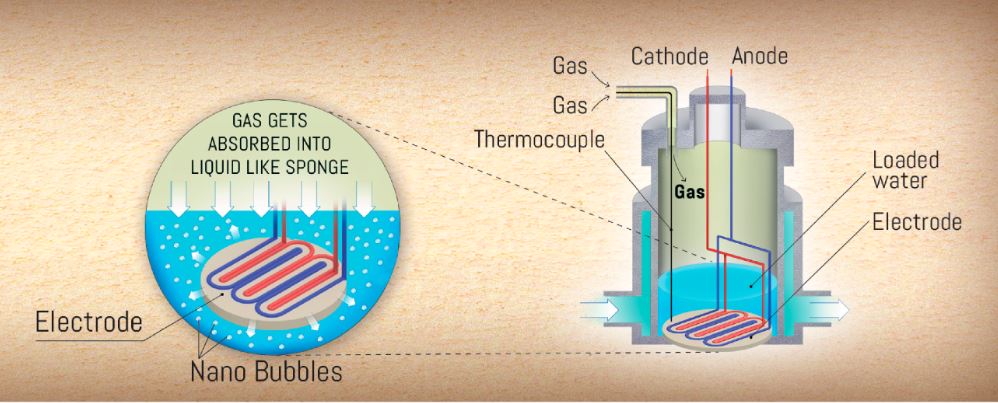
This study demonstrates the potential of EF-ONBs (themselves generated in a
novel and facile way, with solar power as a viable and attractive option) to greatly
enhance the oxidative capacity of water for its disinfection and treatment—using
substantially less parallel (and, of course, energy-/maintenance-intensive) UV
exposure. This original approach of combining state-of-the-art EF-ONBs (and
low-energy, solar-powered/off-grid approaches to generate them, involving dipolar
alignment [35]) with lessening of the level of parallel UV exposure (to the point of
elimination thereof) is striking in its wide-ranging implications. These original findings
are very important in boosting the operational and energy efficiency of O3/UV processing
in disparate fields, such as, inter alia, aquaculture, malting, and advanced oxidation
processes in a whole suite of water-treatment operations, ranging from industrial to
agricultural and ammonia-prone slurries (e.g., in chicken and pig farming). However,
apart from UV irradiation, the attraction of EF-ONBs per se in overcoming more
fundamental barriers of boosting dissolved O2/O3 levels and greater dissolved O3
longevity (perhaps using ORP as a pragmatic and rough “field-metric” thereof) is
very important to highlight. If anything, this is the real “driver” into making ozonation a
more sensible, economic, and operationally feasible option for a wider array of (waste-)
water applications, beyond the degradation of organic chemicals in industrial wastewater
—either with or without parallel UV exposure (and, where UV is required, with substantially
reduced levels thereof). Certainly, penetration of longer-lived O3-NBs through cell-wall
matrices in fish and plants and other living organisms and microbes is of interest to help
inactivate harmful intra-cellular viruses that are undermining and hampering the health
and productivity of (gas-, e.g., oxygen-, consuming) biological systems. This would
certainly be the case for RAS systems in aquaculture and shellfish-virus control, as well
as for O3 cycles as part of recycled-water flow management within optimally healthy and
productive indoor agriculture systems, and, more recently, for the health and wellbeing of
biological communities in barley malting, where cycled-ozonation strategies can make
important productivity and homogenising contributions in the intricate orchestration and
synchronisation of a complex chain of events.
More broadly, one must bear in mind the residence time of the process at play (e.g.,
exposure of shellfish to ozonated waters and the lifetime of ozone NBs inside fish and
their intra-cellular matrices), so as to ensure that these are (somewhat) less than the
“fine-bubble-engineered” dissolved-gas saturation timescales—thereby realising canny
and efficient “just-enough” ozonation strategies, so as to also minimise gas supply and
bubble-generation operating costs. In this way, one can focus more on the exciting finding
of the present study of being able to manipulate and control applied UV inventory to achieve
“just-enough” ozonation and associated oxidative reactivity and optimise operating energy
costs for ozonation processes in various different settings.