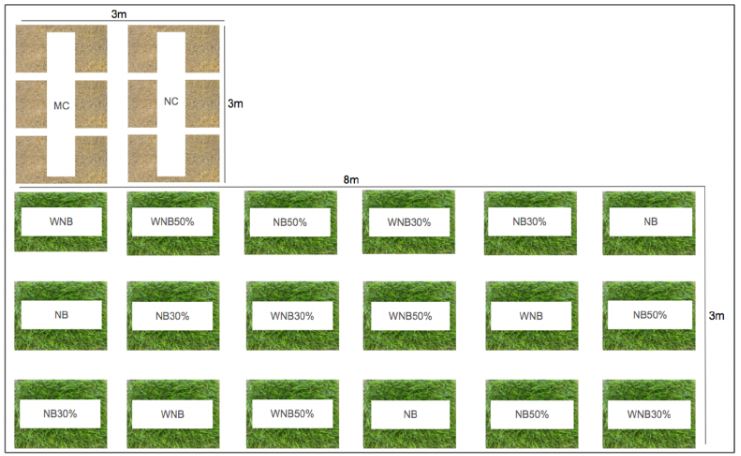
The efficient use of water resources is a growing priority in multiple sectors, including the turfgrass industry. Nanobubbles (NB) represent an innovative technology that, by enriching solutions with various gases, offers significant benefits in several industrial areas. In crop irrigation, they have been shown to increase dissolved oxygen in the root zone and thereby boost yields. The objective of this study was to evaluate the impact of the use of oxygen NB in irrigation water on turfgrass quality, considering different levels of water restriction (0%, 30%, and 50% of daily crop evapotranspiration), compared to conventional irrigation. During the summer of 2024, trials were conducted using turf quality indices based on multispectral reflectance and RGB digital image analysis. The results showed that the use of NB allowed for a reduction in irrigation by 50% without compromising turf quality, reaching values similar to treatments without water restriction. In contrast, treatment with the same restriction but without NB (WNB50%) showed a deterioration in quality. This study shows NB as an innovative tool to optimize water use, with great potential for applications in landscape green areas, promote water use efficiency, and reduce the costs associated with irrigation
.png)
The enrichment of irrigation water with nanobubbles of oxygen (NB) in this studyallowed us to restrict water irrigation by 50% without compromising turfgrass qualityand to maintain it at the level of unrestricted irrigation control without NB. We suggestthat the benefits of NB could be related to their ability to elevate and stabilize dissolved oxygen in the water and thereby increase oxygen in the root zone. This would directlyinfluence microbial community diversity and species interactions, promoting them throughthe destabilization of macroaggregates and decomposition of unstable organic carbon,resulting in soil fertility and permeability, water retention, and crop yield. In addition, dueto the ability of NB to generate reactive oxygen species (ROS), they would promote thephysiological activities of plants and thus their growth and development, allowing for amore efficient use of available water. This preliminary study positions oxygen nanobubblesas a potential applicable technology in the turfgrass industry and the environment toaddress the challenges associated with sustainable resource management and the growingdemand for functional green spaces; however, more studies are needed to confirm thelong-term benefits and understand the mechanisms of action in specific turfgrass varieties