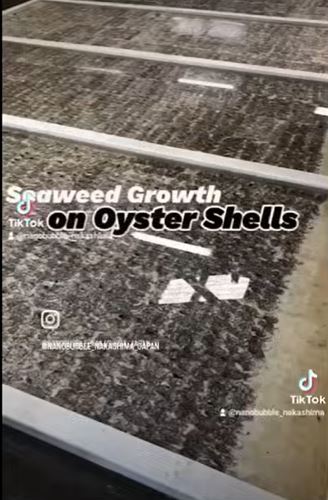
1. Higher Dissolved Oxygen at the Substrate Surface
The greatest challenge during seaweed spore attachment is that the thin boundary layer surrounding the substrate can become oxygen-depleted.
Oxygen nanobubbles:
* Maintain high dissolved oxygen immediately around the oyster shell.
* Diffuse oxygen continuously due to their long residence time.
* Reduce localized hypoxia between densely packed shells.
Benefits
* Faster spore germination.
* Better survival of newly attached spores.
* Healthier juvenile thalli.
2. Enhanced Cellular Respiration
Young seaweed spores have high metabolic demands.
With oxygen nanobubbles:
* ATP production increases.
* Cell division proceeds more efficiently.
* Photosynthetic tissues develop more rapidly.
Possible outcomes:
* Faster blade initiation.
* Larger juvenile seaweed.
* More uniform growth.
3. Improved Photosynthetic Efficiency
Photosynthesis requires healthy oxygen dynamics.
Nanobubbles can:
* Improve water circulation at the microscopic scale.
* Reduce stagnant boundary layers.
* Enhance gas exchange around algal tissues.
Potential effects include:
* Higher chlorophyll activity.
* Greater carbohydrate production.
* Increased daily biomass accumulation.
4. Cleaner Oyster Shell Surface
As nanobubbles gradually collapse they can generate mild oxidative effects (especially if reactive oxygen species are produced), which may:
* Reduce bacterial biofilm accumulation.
* Decrease organic slime.
* Prevent excessive fouling.
Cleaner shell surfaces provide:
* Better spore attachment.
* Reduced competition from nuisance microorganisms.
* Improved survival during early colonization.
5. Increased Spore Attachment Rate
A clean, oxygen-rich substrate generally supports better adhesion.
Benefits include:
* Higher percentage of spores remaining attached.
* Reduced spore loss due to water movement.
* More even colonization across oyster shells.
6. Reduced Anaerobic Zones
Stacks or baskets of oyster shells often develop oxygen-poor areas.
Nanobubbles help by:
* Penetrating into narrow gaps.
* Delivering oxygen where conventional aeration is less effective.
* Limiting anaerobic microbial activity.
This can reduce:
* Sulfide formation.
* Organic decomposition.
* Localized tissue stress.
7. Healthier Microbial Community
Higher dissolved oxygen favors aerobic microorganisms.
This can:
* Suppress anaerobic bacteria.
* Promote beneficial biofilms.
* Improve nutrient cycling near the substrate.
A healthier microbial environment often benefits seaweed spore establishment.
8. Improved Nutrient Uptake
Active metabolism supported by adequate oxygen can enhance the uptake of dissolved nutrients such as:
* Nitrate (NO₃⁻)
* Ammonium (NH₄⁺)
* Phosphate (PO₄³⁻)
* Iron (Fe)
This can contribute to:
* Faster tissue expansion.
* Higher protein synthesis.
* Stronger pigmentation.
9. Better Stress Resistance
Nanobubble-treated water may help seaweed tolerate environmental stress by:
* Maintaining stable oxygen levels.
* Reducing oxidative stress associated with hypoxia.
* Supporting faster recovery after handling or transport.
Potential benefits include greater resilience to:
* High temperatures.
* Low water exchange.
* Temporary turbidity.
10. Increased Biomass Production
When combined with suitable light, nutrients, and water movement, oxygen nanobubbles may lead to:
* Faster juvenile growth.
* Earlier harvest.
* Greater biomass yield.
* Improved consistency among cultivation units.