Oxygen Microbubble for higher survival rate and health of fingerlings during long transport and recovery process
Oxygen Microbubble for higher survival rate and health of fingerlings during long transport and recovery process
#tilapia #baramundi #catfish
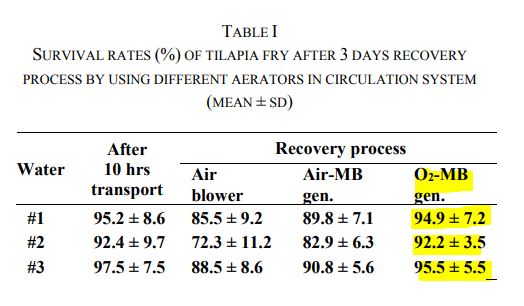
Using oxygen microbubbles (typically 20–100 μm) during fish fingerling transport and post-transport recovery can significantly improve survival, reduce stress, and enhance subsequent growth. Compared with conventional air stones, oxygen microbubbles have much higher gas transfer efficiency because they rise slowly, remain suspended for longer, and dissolve oxygen more effectively.
During long-distance transport
1. Maintains high dissolved oxygen (DO)
The primary cause of mortality during transport is oxygen depletion.
Oxygen microbubbles:
* Continuously release oxygen throughout the water column.
* Produce more uniform DO distribution.
* Minimize oxygen-depleted zones in crowded transport tanks.
* Allow oxygen levels to remain close to saturation even at high stocking densities.
Typical benefits include:
* Reduced suffocation
* Higher survival
* More consistent oxygen supply throughout the trip
2. Reduces handling stress
Fingerlings experience several stressors:
* Netting
* Grading
* Loading
* Vehicle vibration
* Crowding
Stress increases:
* Oxygen consumption
* Cortisol release
* Ammonia excretion
Because microbubbles maintain stable oxygen concentrations, fish expend less energy on respiration, helping to:
* Reduce stress hormones
* Lower metabolic demand
* Maintain more normal swimming behavior
3. Improves gill oxygen uptake
Unlike coarse bubbles that rapidly escape to the surface, microbubbles:
* Stay suspended longer.
* Increase contact time between oxygen and water.
* Create a more uniform oxygen-rich environment around the fish.
This allows:
* Better oxygen diffusion across the gills.
* Lower respiratory effort.
* Reduced gill fatigue during extended transport.
4. Supports higher transport density
One of the largest operational benefits is the ability to safely transport more fish per tank.
With sufficient oxygen transfer:
* More fingerlings can be stocked.
* Water quality remains more stable.
* Oxygen becomes less of a limiting factor.
Actual density limits still depend on species, fish size, temperature, ammonia accumulation, and transport duration.
5. Reduces accumulation of carbon dioxide
Fish continuously produce CO₂.
Although microbubbles are primarily used for oxygen delivery, their circulation promotes gas exchange, helping:
* Reduce dissolved CO₂.
* Maintain a more stable pH.
* Prevent respiratory acidosis.
6. Helps stabilize water quality
Well-designed microbubble systems improve mixing and reduce stagnant areas, resulting in:
* More uniform temperature.
* More consistent oxygen levels.
* Even distribution of metabolites.
This creates a less stressful environment throughout the transport container.
Benefits immediately after transport (Recovery phase)
Recovery is often when delayed mortality occurs because fish remain physiologically stressed.
1. Rapid restoration of blood oxygen
Once fingerlings enter recovery tanks with oxygen microbubbles:
* Blood oxygen levels recover quickly.
* Normal respiration resumes.
* Swimming behavior normalizes sooner.
This shortens the recovery period.
2. Reduces delayed mortality
Fish that appear healthy upon arrival may die 12–48 hours later due to accumulated transport stress.
High oxygen availability during recovery:
* Supports tissue repair.
* Reduces metabolic exhaustion.
* Increases resistance to secondary infections.
Many hatcheries observe lower delayed mortality when recovery tanks maintain high, stable DO.
3. Faster healing of minor injuries
Handling can cause:
* Scale loss
* Fin damage
* Skin abrasions
Oxygen is essential for:
* Cell repair
* Collagen synthesis
* Immune cell function
Higher dissolved oxygen accelerates wound healing and reduces opportunities for opportunistic pathogens.
4. Improved immune function
Stress suppresses immunity.
Adequate oxygen supports:
* White blood cell activity.
* Mucus production.
* Tissue regeneration.
* Disease resistance.
This is particularly valuable in hatcheries where fingerlings are vulnerable to bacterial infections after transport.
5. Earlier resumption of feeding
Fish recover appetite more quickly when oxygen is abundant.
Benefits include:
* Earlier first feeding.
* Better feed conversion.
* Less weight loss during transport.
* More uniform growth.
6. Improved size uniformity
When oxygen is consistently available:
* Smaller or weaker fish are less likely to be outcompeted.
* Stress-related growth suppression is reduced.
* The population becomes more uniform in size over time.