https://journals.unpad.ac.id/kultivasi/article/view/66626/26908
Drip fertigation is a fertilization method that integrates nutrient delivery with an irrigation
system, which is capable of optimizing the direct delivery of nutrients to the root zone. This experiment
aims to investigate the effect of drip fertigation with nanobubble technology, and soil conditioners on
the population of Phosphate-Solubilizing Bacteria (PSB) and Azotobacter spp., available phosphorus,
total nitrogen, growth, and yield of red chili. The study used a Strip Plot Design with two factors and
three replications. The first factor was nutrient application (solid NPK fertilizing as control; drip
fertigation; and drip fertigation with nanobubble technology), and the second factor was soil
conditioner application (cow manure fertilizer; bioameliorant; and ameliorant). The measured
parameters included PSB and Azotobacter spp. population, available phosphorus, total nitrogen, growth
components (plant height, number of leaves, and stem diameter), and yield components (number of
fruits per plant, fruit weight per plant, and yield quality). The results showed that the interaction
between drip fertigation with nanobubble technology and soil conditioners significantly influenced the
increase in PSB population and available phosphorus. Drip fertigation treatment with nanobubble and
ameliorant application gave the best effect on the PSB population and P available. Nutrient application
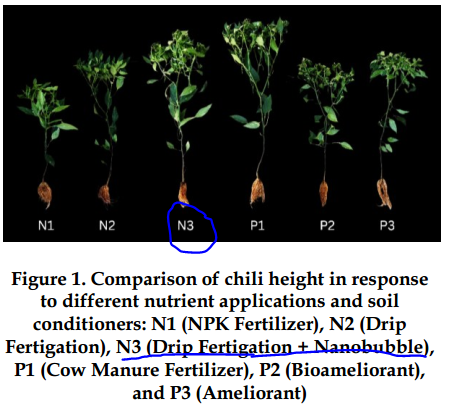
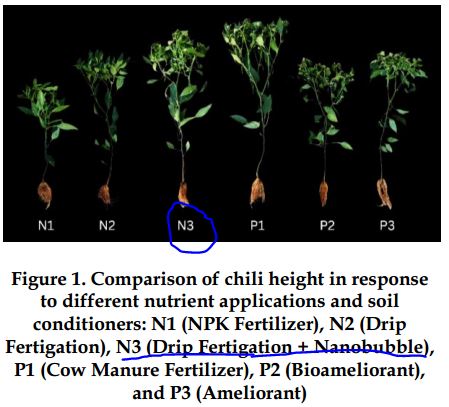
significantly affected plant height, stem diameter, number of fruits per plant, and fruit weight per plant.
Soil conditioner application significantly affected total nitrogen, plant height, number of leaves, stem
diameter, number of fruits per plant, and fruit weight per plant