Growrate and Final Weight increase for Tambaqui Fish with Microbubbles
https://e-journal.unair.ac.id/JAFH/article/view/43381
Oxygen plays an important role in aquaculture by serving
as an essential component for oxidizing food substances to produce energy,
thereby influencing metabolic rates often quantified by oxygen consumption per unit of time.
Particularly in intensive aquaculture systems characterized by high stocking densities and
maximal feeding rates, oxygen content assumes paramount importance.
This study aimed to evaluate the growth performance of tambaqui (Colossoma macropomum)
treated with increased oxygen in two different systems.
The study was conducted on a laboratory scale by applying Ttest data analysis.
The difference in treatment level applied when comparing aeration and microbubble consists of two
treatments and three replications. This research used commercial floating pellets PF0 with
25% protein content, the feeding rate was 5% of the biomass. The feed was given daily during
the culture for two times a day.
Data from the study were analyzed using a T-test on the Statistical Product and Service Solutions
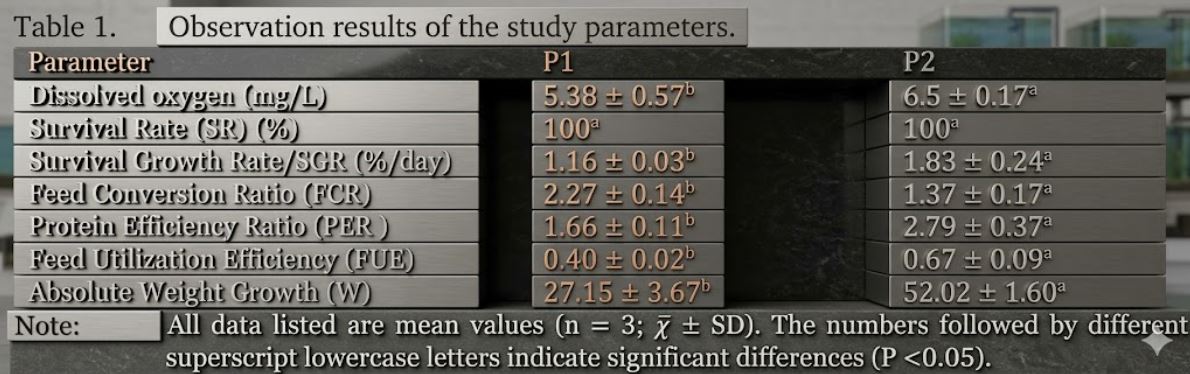
(SPSS) software Version 17.0. Results of the study showed that aeration system using microbubble resulted in
dissolved oxygen (DO) of 6.5 ± 0.17, 100% pomfret fish survival rate (SR), Survival Growth Rate (SGR) of 1.83 ± 0.24,
Feed Conversion Ratio (FCR) of 1.37 ± 0.17, Protein Efficiency Ratio (PER) of 2.79 ± 0.37, Feed Utilization Efficiency
(FUE) of 0.67 ± 0.09, Absolute Weight Growth of 52.02 ±1.60; it was better than using aeration.
This study has developed a model of tambaqui aquaculture to provide growth value.