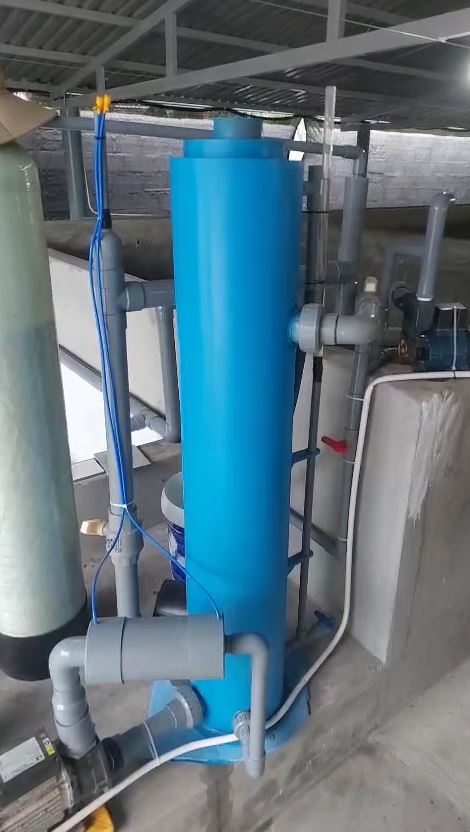
Freshwater Protein Skimmer : Counter Current design and 35-45 second contact time
A counter-current protein skimmer is one of the most valuable water treatment components in an intensive eel (Anguilla spp.) RAS (Recirculating Aquaculture System) because eels produce relatively high amounts of mucus, dissolved proteins, fine suspended solids, and organic waste. These compounds can rapidly degrade water quality if they are not removed before biological decomposition.
1. Superior Removal of Dissolved Organic Compounds (DOC)
The counter-current design provides a long contact time between rising fine bubbles and descending water.
Benefits include:
* Removes dissolved proteins
* Removes amino acids and peptides
* Removes eel mucus
* Removes fish oils and lipids
* Removes surfactants
* Removes yellow-colored dissolved organics
Compared with co-current skimmers, counter-current systems typically achieve:
* Higher DOC removal efficiency
* Better foam concentration
* Lower energy per unit of waste removed
2. Reduces Ammonia Formation
Protein skimmers remove organics before bacteria decompose them** into:
* Ammonia (NH₃)
* Nitrite (NO₂⁻)
* Nitrate (NO₃⁻)
This provides several advantages:
* Lower biofilter loading
* Improved nitrification stability
* Lower oxygen consumption by heterotrophic bacteria
* Reduced accumulation of dissolved waste
3. Excellent Removal of Eel Mucus
Eels continuously produce mucus for:
* Disease protection
* Stress response
* Skin lubrication
Large amounts of mucus cause:
* Sticky suspended solids
* Foam formation
* Clogged filters
* Increased BOD
* Higher bacterial growth
A protein skimmer efficiently removes this mucus before it decomposes.
This is especially valuable after:
* Grading
* Harvesting
* Handling
* Transport
* High stocking density
4. Lower Biological Oxygen Demand (BOD)
Removing organics reduces bacterial respiration.
Benefits include:
* More oxygen available for eels
* Reduced oxygen demand overnight
* Lower blower energy
* More stable dissolved oxygen
5. Improves Water Clarity
Fine suspended organic particles attach to microbubbles and are removed as foam.
Water becomes:
* Clearer
* Less yellow
* Lower turbidity
* Better light penetration (if applicable)
Although eels do not require bright water, clearer water improves:
* Observation of fish behavior
* Feeding management
* Early disease detection
6. Reduces Fine Suspended Solids
Counter-current skimmers remove particles that often bypass mechanical drum filters, including:
* Fecal fines
* Feed dust
* Biofilm fragments
* Bacterial flocs
* Mucus aggregates
This lowers the burden on downstream filtration.
7. Lower Bacterial Load
Many bacteria adhere to organic particles.
Removing those particles also removes:
* Opportunistic bacteria
* Vibrio spp.
* Aeromonas spp.
* Pseudomonas spp.
This can reduce disease pressure, though it is not a replacement for proper biosecurity.
8. Reduces Off-Flavors
Organic accumulation promotes compounds responsible for earthy or musty flavors, such as:
* Geosmin
* 2-MIB (2-methylisoborneol)
While protein skimmers do not directly remove all dissolved flavor compounds, they reduce the organic precursors that support their production, helping improve product quality.
9. Improves Biofilter Performance
Cleaner water entering the biofilter means:
* Less clogging
* Better oxygen diffusion
* More stable nitrification
* Lower maintenance frequency
* Longer media lifespan
10. Better Ozone Utilization (If Ozone Is Used)
Many advanced eel RAS facilities inject ozone into the protein skimmer.
Benefits include:
* Higher oxidation efficiency
* Lower ozone demand
* Better water color removal
* Reduced microbial load
* More effective disinfection with lower ozone dosage
The foam fractionation column also serves as an effective ozone contact chamber.
11. Increases UV Sterilizer Efficiency
UV systems perform better when water contains fewer suspended particles.
Cleaner water allows:
* Greater UV transmission
* More effective microbial inactivation
* Reduced lamp fouling
12. Lower CO₂ Accumulation
A counter-current skimmer also functions as a gas exchange column by:
* Stripping dissolved CO₂
* Removing excess nitrogen
* Enhancing oxygen transfer (if supplied with oxygen-enriched air)
Lower CO₂ benefits include:
* Improved respiration
* Better feed intake
* Reduced stress
* Enhanced growth
13. Improved Feed Conversion Ratio (FCR)
Cleaner water supports:
* Better appetite
* Lower chronic stress
* Improved digestion
* Higher metabolic efficiency
Commercial eel farms often observe improved FCR when water quality remains consistently high.
14. Higher Carrying Capacity
With cleaner water and lower organic loading, the RAS can safely support:
* Higher stocking densities
* Increased feeding rates
* Greater biomass per cubic meter
* More stable water quality over time
This can improve overall production without expanding tank volume.