https://youtube.com/shorts/VxBUpMlFEgc
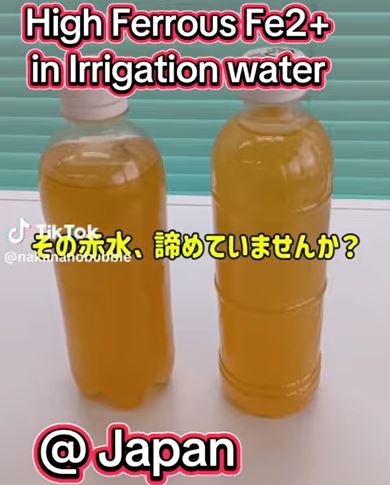
How Nanobubbles help in treatment of groundwater with high ferrous ion content:
High Oxygen Transfer Efficiency
Kinetics of converting Fe++ into Fe+++ depend greatly on the concentration of dissolved oxygen (DO) in the water
.png)
Inherent Generation of Hydroxyl Radicals by Microbubble break-up
Hydroxyl radicals have a significantly higher oxidation potential than standard molecular oxygen (O-O).
They instantly attack and oxidize Fe++ ions on contact, thus shortening the reaction time significantly
Accelerated Flocculation and Coagulation
Hydrates of Ferric Hydroxide Fe(OH)3 are formed when Fe++ is oxidized into Fe+++.
Such hydrates can clump together (flocculate) into rusty-brown particulates
Zeta Potential Interaction:
The strong negative surface charge of nanobubbles acts as a physical binder.
It attracts the newly formed, positively charged ferric iron precipitates
Enhanced Particle Agglomeration:
Nanobubbles bridge the micro-flocs together, promoting the formation of larger, denser flocs.
This makes subsequent physical separation—whether through multi-media filtration, sedimentation,
or dissolved air flotation (DAF)—far more efficient