https://www.mdpi.com/2410-3888/10/11/550?utm
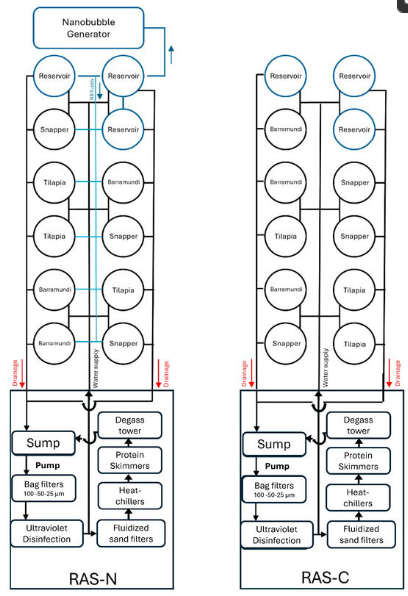
Recirculating aquaculture systems (RAS) address pollution, disease
, and sustainability in commercial fish farming, but marine RAS are
limited by biofilter maturation and nitrification. This study investigated
the effects of air nanobubbles on water quality, fish growth, and bacterial
communities in marine RAS stocked with juvenile Malabar red snapper,
barramundi and saline-tolerant hybrid tilapia. Flow cytometry was
evaluated as a rapid management tool for non-culturable microbes,
finding viable bacterial counts 30–100 times higher than conventional
total plate counts. There were no significant differences in fish growth,
survival, or Feed Conversion Ratio between groups, likely due to low
stocking densities (<20 kg/m3) and high water exchange rates (>100%/hour),
indicating low system stress. Air nanobubbles did not significantly
increase dissolved oxygen levels. While bacterial abundance in water
was consistently higher in nanobubble-treated RAS (RAS-N), tank walls
showed less biofilm. RAS-N also exhibited a higher abundance of nitrifying
bacteria like Nitrospira and Marinobacter, leading to improved nitrogenous
waste breakdown and lower nitrite levels. Future research should investigate
nanobubbles’ benefits at higher stocking densities and longer durations to
fully assess their impact on intensive aquaculture
.png)
This study demonstrated that air nanobubble enrichment in marine RAS
significantly altered microbial community structure, with 16S rRNA analysis
revealing an increased abundance of nitrifying bacteria (Nitrospira and
Marinobacter) that corresponded with enhanced nitrogen cycling and lower
nitrite levels. However, these water quality improvements did not translate
into enhanced growth performance, Feed Conversion Ratio, or survival in
barramundi, red snapper, or tilapia at stocking densities below 20 kg/m3
with high water exchange rates. Flow cytometry proved to be an efficient
method for monitoring bacterial abundance in intensive aquaculture systems,
with 96-well plate analysis enabling high-throughput, same-day results and
revealing 30- to 100-fold higher viable bacterial counts than traditional plate
counts. Future research should investigate whether nanobubble benefits
become apparent at commercial stocking densities (>30 kg/m3) over full
production cycles (12–18 months), comparing air and oxygen nanobubbles
with oxygen-matched controls, and utilizing 16S rRNA analysis of replicate
tank samples at multiple time points to better characterize the temporal
dynamics of microbial community succession.