https://www.sciencedirect.com/science/article/pii/S1385894724077271?via%3Dihub
.png)
Ozone Nanobubbles increase the degradation by three folds compared to Ozone microbubbles.
Rapid degradation of TC antibiotic at pH 4 and high salinity wastewater conditions.
High applicability for real wastewater under lower concentrations of antibiotic.
Scavenging experiments confirmed radical mechanism of pharmaceutical degradation.
Presence of pharmaceuticals, especially antibiotics, in industrial and domestic
effluents causes serious damage to the environment. Classic wastewater treatment
processes, in particular conventional biological treatment methods, are not sufficient
to rapidly eliminate antibiotics. Typically, Advanced Oxidation Processes (AOPs)
based on activation of hydrogen peroxide, ozone or persulfate for formation of
particular type of radical species or singlet oxygen are used. A one of cutting-edge
technologies to increase effectiveness of AOPs based on ozone are nanobubbles
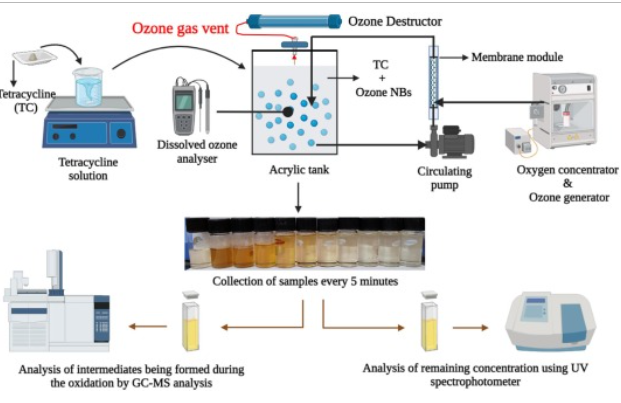
based processes. Thus, this paper focuses on utilization of ozone in the form of
nanobubbles for degradation of tetracycline (TC). The effects of several reaction
parameters, such as antibiotic concentration, ozone intake, pH, presence of salts,
were investigated. This study revealed that the presence of ozone nanobubbles
had a substantial positive impact on the degradation of TC. This improvement
may be attributed to the enhanced mass transfer and the production of reactive
radicals that occur during the collapse of the nanobubbles. Identification of Reactive
Oxygen Species (ROS) revealed a significant contribution of hydroxyl radicals
in the degradation of the antibiotic. AOP based on O3 nanobubbles generated
mostly hydroxyl (•OH) and superoxide anion (O2•–) radicals providing 100 %
degradation of 100 mg/L TC within 20 min at 8 mg/L ozone concentration.
Based on identified by LC-MS intermediates a detailed degradation mechanism
has been described. Degradation of TC and intermediates transformations
included methylation, hydroxylation, ring-opening steps as well as cleavage
of C-N bonds. This research introduces a novel technique combining
nanobubbles with advanced oxidation processes (AOPs), which is anticipated
to provide enhanced efficiency and environmental sustainability.
Tetracycline (TC) is a widely used antibiotic that is useful in treating a wide
range of infectious disorders. The chemical and biological properties of tetracycline,
such as its non-biodegradable nature and the development of resistance to its effects,
present significant concerns. This study aimed to examine the degradation of
tetracycline through ozone nanobubbles while considering various operational
parameters. The results indicated that employing ozone nanobubbles at a
lower pH level (pH = 4) and lower salt concentrations (0.1 mM NaCl) resulted
in enhanced ozone concentration, as well as more effective degradation of
tetracycline compared to other combinations. The degradation kinetics follow
pseudo-second-order kinetics using ozone nanobubbles which is better compared
to first-order kinetics reported for sole ozonation. It is to be noted here that comparisons
were made based on the same reactor volume. After comparing the effectiveness
of other methods, it was found that using ozone in the form of nanobubbles produced
the best degradation efficiency. This technique could work with actual wastewater from
the medical and pharmaceutical sectors since ozone nanobubbles can treat solutions
with high concentrations. Preserving the high potential of ozonation requires avoiding
the presence of •OH radical scavengers, such as 2-Propanol, as the oxidation process
of •OH radicals are one of the essential processes in the mineralization of organic
molecules. The presence of intermediates was verified through LC-MS analysis.
O3 and •OH has the ability to target the ortho or para position of the phenol ring on TC.
Additional oxidation causes the unstable intermediates to ultimately breaking down into
inorganic compounds like CO2, H2O, and NH4+. Ozone nanobubbles have the potential
to enhance AOPs by lowering expenses and the need for chemicals. This work offers a
new technique for enhancing conventional advanced oxidation processes, and nanobubbles
and AOPs will play a significant role in the very effective removal of contaminants.
Therefore, the best results with parameters for 100 % degradation were at 100 mg/L of
TC at 8 mg/L (10 L/min) concentrations of dissolved ozone within 20 min of time span.
Future studies will focus on scaling up the ozone nanobubble technology to promote a
practical approach to the degradation of wastewater containing antibiotics.
Optimization of parameters such as ozone consumption, cost effectiveness,
energy consumption can be studied. On the other hand, it is worth exploring the
degradation mechanism of other types of antibiotics having different structural
characteristics by ozone in the form of nanobubbles. Comparison of the
conventional AOPs with the ozone nanobubbles in terms of degradation rates,
efficiency, by-product formation and energy consumption can be carried out to
get better insights on the advantages of ozone nanobubbles.