https://www.sciencedirect.com/science/article/pii/S2772427125000919
antibiotics use and promoting growth.
Vibrio spp. in water reduced 4-fold, resulting in lower V. parahaemolyticus in shrimp gut.
Water quality improved with 50 % lower NH₃-N, reduced COD, and higher DO and ORP.
Ozone Nanobubbles did not negatively impact on shrimp health
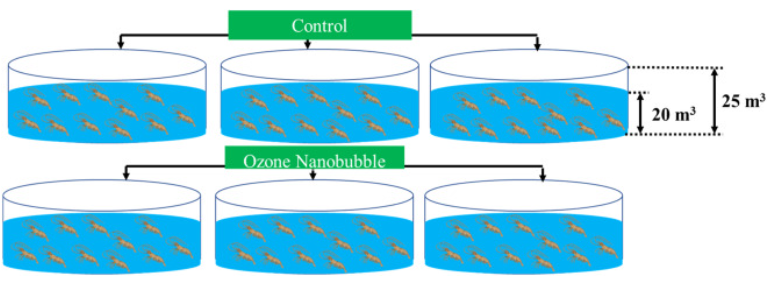
This study evaluated the effects of ozone nanobubbles (NB-O₃) on water quality,
growth performance, survival rate, and gut microbiota in intensive indoor farming of
white-leg shrimp (Penaeus vannamei). The experiment lasted 12 weeks and included
two groups: (1) NB-O₃ treatment at 0.3 mg/L ozone concentration and (2) a control
group without NB-O₃ treatment. Water quality parameters including temperature,
dissolved oxygen (DO), pH, and Oxidation–Reduction Potential (ORP) were monitored
daily. Weekly analyses were conducted for Chemical Oxygen Demand (COD), Biochemical
Oxygen Demand after 5 days (BOD₅), Ammonia Nitrogen (NH₃-N), Nitrite Nitrogen (NO₂-N),
and Vibrio counts. Shrimp weight was recorded weekly, while final biomass (FB), final body
weight (FBW), survival rate (SR), feed conversion ratio (FCR), specific growth rate (SGR),
and mean weekly weight gain (MWWG) were evaluated at the end of study. Gut microbiota
samples were collected on days 1, 60, and 84. The results showed that NB-O₃ significantly
reduced COD, total Vibrio, and NH₃-N levels compared to the control (p < 0.05). Shrimp in
the NB-O₃ group exhibited significantly higher weights from week 5 onwards (p < 0.05),
with improved FB, FBW, SGR, and MWWG compared to the control (p < 0.05). However,
SR and FCR were lower in the NB-O₃ group (p < 0.05). Dominant gut microbiota phyla in
NB-O₃-treated shrimp were Proteobacteria, Bacteroidota, and Acinobacteriota, with their
proportions recorded as 72.27 %, 13.82 %, and 6.72 % on day 1; 60.75 %, 17.16 %, and
18.64 % on day 60; and 45.74 %, 40.25 %, and 8.44 % on day 84, respectively. Significant
differences in alpha and beta diversity were observed between groups on days 1 and 60
(p < 0.05). Vibrio parahaemolyticus density was lower in NB-O₃-treated shrimp (p < 0.05).
These findings demonstrate that NB-O₃ improves water quality, enhances shrimp growth
performance, and effectively regulates Vibrio spp. in intensive indoor farming systems.
To the best of our knowledge, this is the first study to report the effects of NB-O3 on shrimp
gut microbiota.
.png)