https://www.sciencedirect.com/science/article/abs/pii/S1383586617325753?via%3Dihub
Synergistic effect of ozone microbubble and catalyst enhanced  OH oxidation.
More efficient TOC removal in catalytic microbubble ozonation even at low pH.
The performance of catalytic microbubble (MB) ozonation using a commercial granular
activated carbon (AC) as catalyst in synthetic acid red 3R wastewater treatment was
more efficient than that of coarse bubble (CB) and MB ozonation alone. The ozone
mass transfer coefficient, ozone decomposition coefficient, decolorization rate
constant, TOC removal rate constant, and ozone reaction efficiency achieved
in catalytic MB ozonation were 0.253 min−1, 0.093 min−1, 0.342 min−1, 0.0242 min−1
and 0.128 mg(TOC removed)/mg(ozone consumed), respectively. The average ozone
utilization efficiency in catalytic MB ozonation was as high as 98.3%. The synergistic
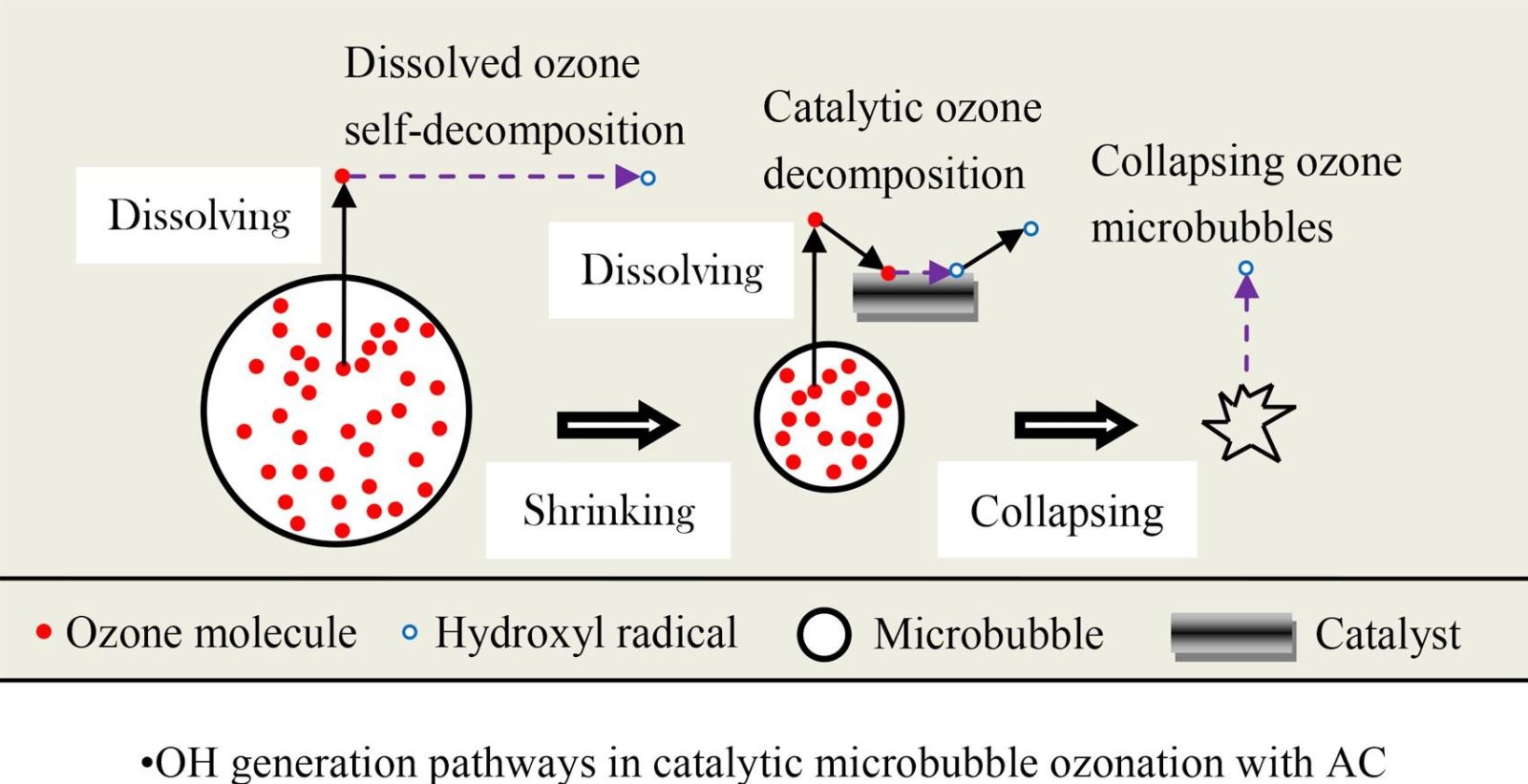
effect of collapsing ozone MBs and catalytic activity of AC enhanced hydroxyl
radicals (OH) oxidation in catalytic MB ozonation which provided about 75% of
oxidative capacity for TOC removal, even at a low pH. The enhanced OH
oxidation was crucial for the mineralization of acid red 3R in catalytic MB ozonation
where some OH scavengers could make TOC removal less efficient, especially
Na2CO3. In addition, the catalytic activity of this commercial AC seemed stable
after five recycling cycles. UV–Vis spectra and GC–MS analyses indicated that
acid red 3R was oxidized-degraded by a pathway of azo bond cleavage, formation
of naphthalene- and benzene-type compounds, further generation and final
mineralization of small organic acids, which initially reduced the pH and increased
the value again during catalytic MB ozonation. Therefore, the catalytic MB ozonation
with commercial granular AC was a promising solution for wastewater treatment
by ozonation process.