https://link.springer.com/article/10.1007/s11270-025-08803-4
Global agricultural systems face unprecedented challenges in meeting
rising food demand while maintaining environmental sustainability,
with soil oxygen deficiency and contamination threatening both crop
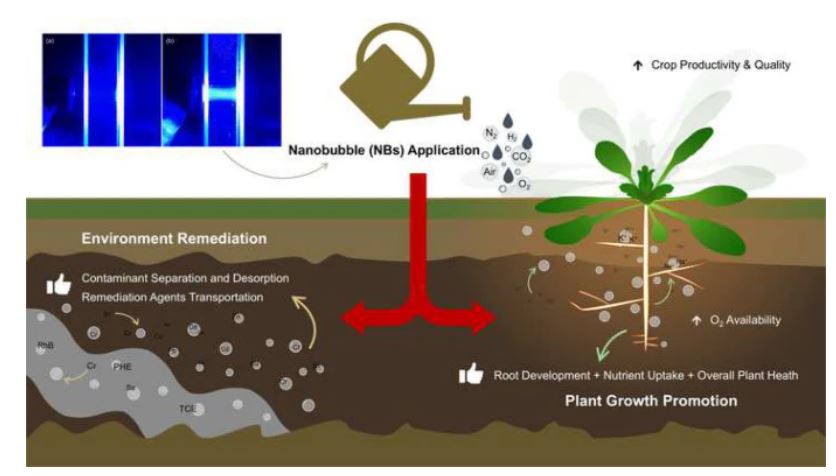
productivity and soil health. Nanobubble (NB) technology, featuring
gas-filled spheres < 1 μm in diameter, has emerged as a promising
dual-function solution for simultaneous plant growth enhancement and
environmental remediation. This review systematically analyzes current
knowledge on NB mechanisms in agricultural systems, identifying key
factors governing their effectiveness in both plant growth promotion
and soil remediation applications. We comprehensively examine NB
stability and transport behaviors in soil matrices, remediation mechanisms
for various contaminants, including heavy metals and organic pollutants,
and plant growth enhancement pathways through rhizosphere oxygenation
and nutrient transport optimization. The analysis integrates findings from
recent studies (2018–2025) across laboratory, greenhouse, and limited
field-scale applications. NBs demonstrate dual functionality through surface
charge-mediated stability, enhanced mass transfer efficiency, and context-dependent
effectiveness varying with soil properties, gas type, and application parameters.
Plant growth improvements of 10–50% are commonly reported, as well as significant
contaminant removal efficiencies reaching 75–98% for various pollutants. However,
economic feasibility and long-term environmental impacts remain underexplored.
While NB technology shows substantial promise for sustainable agricultural
intensification, successful implementation requires standardized protocols,
field-scale validation studies, and comprehensive economic analysis to address
current knowledge gaps in scalability and long-term ecosystem effects.
Overall, this review compiles scattered information on the NB application within
agricultural practices, thereby providing new insight to guide future research efforts.