https://www.chemengonline.com/stable-nanobubbles-promote-cleaner-effluents-dairy-plants/
Wastewater from dairy processing facilities can be extremely challenging to treat
— not only does the effluent usually contain high volumes of solids, minerals and
organic matter, these loads can vary widely from hour to hour. A large cheese-processing
facility operated by Valley Queen in Milbank, S.D. is among the first dairy manufacturers
to employ a nanobubble-based treatment technology to help treat its wastewater.
“Nanobubbles are negatively charged, have free radicals on their surface and are
stable for extended periods of time from a few days to months. Dairy processing
wastewater is rich in different organic compounds and salts, and is high in total
suspended and dissolved solids. Nanobubbles react with these suspended and dissolved
solids, leading to increased rates of oxidation of the organic matter. This increases the
wastewater treatment efficiency and will improve the quality of effluent for discharge to the
environment,” explains Maneesha Mohan, professor at the department of dairy and food
science at South Dakota State University (SDSU; www.sdstate.edu), who has been
instrumental in the development of nanobubble effluent-treatment processes. Generated
using oxygen, compressed air or other gases, the nanobubbles effectively increase oxidation
rate and significantly decrease the chemical oxygen demand (COD) and biological oxygen
demand (BOD) of the effluent, which are important markers of effluent quality for environmental discharge.
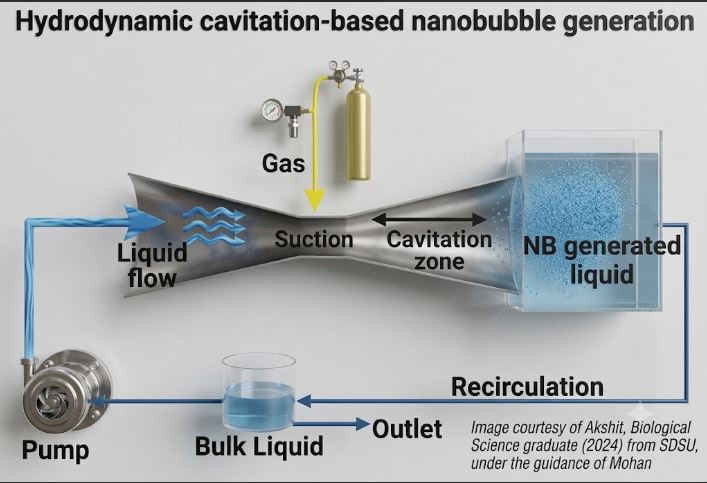
To form the nanobubbles, liquid is pumped into a generator where gas is swirled through the
liquid, causing hydrodynamic cavitation (diagram) that breaks down larger gas bubbles eventually
into nano-sized bubbles (below 1 μm in diameter). The stability of the nanobubbles in liquid
supports their interaction with different compounds over periods ranging from a few days to
a few months. Also, their small size imbues the nanobubbles with very large specific surface
areas and high mass-transfer efficiency when compared to larger bubbles.
“The findings from Valley Queen indicate that regardless of the variation in the effluent load
from day to day, there is significant reduction in the BOD and COD levels of the effluent.
Hence, the nanobubble effluent-treatment technology is very effective and has significant
commercial potential for dairy processing,” adds Mohan.