https://www.sciencedirect.com/org/science/article/pii/S2046206925015591
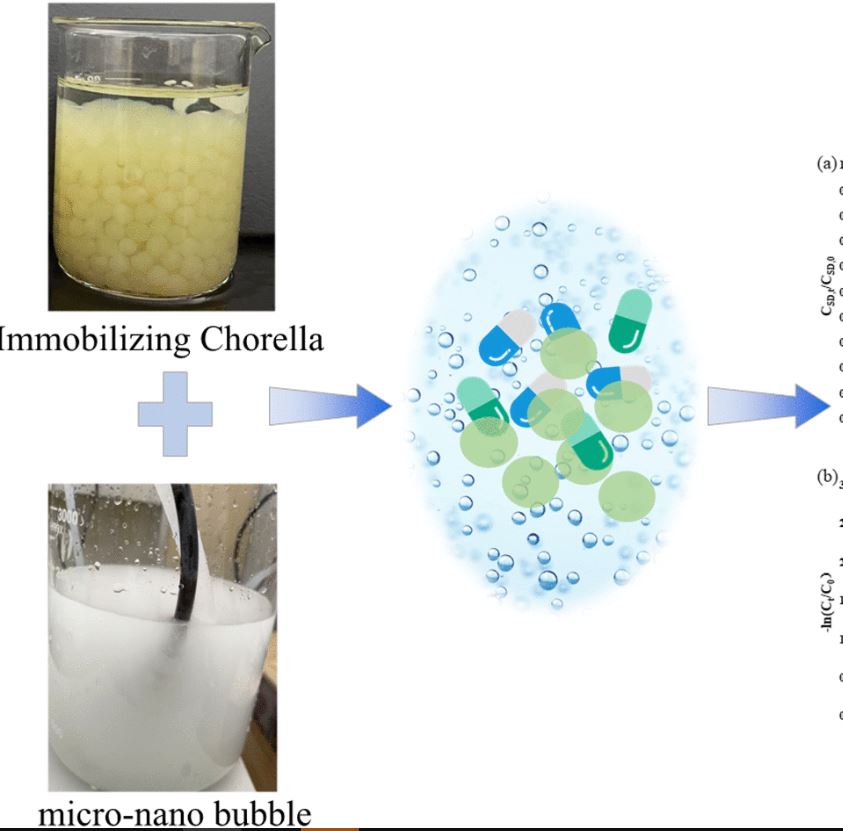
Antibiotic pollution poses a global environmental challenge, with effective removal technologies for different antibiotic types still lacking. This study investigates an innovative micro–nano bubble (MNB)-augmented immobilized Chlorella vulgaris system for remediating groundwater contaminated with sulfadiazine (SD) and chloramphenicol (CAP) antibiotics. Key parameters, including initial concentration (5–30 mg L−1), algal bead density (0.25–4 beads per mL), aeration time (5–30 min), and coexisting ions, were evaluated. SEM and FT-IR analyses revealed removal mechanisms. Results showed MNBs significantly improved microalgal biomass and removal efficiency (SD: 79.97%; CAP: 93.92%). SD elimination primarily depends on initial concentration and aeration, while CAP removal shows stronger ionic environment dependence. FT-IR confirmed stronger interactions (electrostatic attraction, surface adsorption) between algae and CAP. The technology showed particular effectiveness for CAP, achieving over 90% removal through MNB-algae synergy, providing valuable insights for targeted antibiotic remediation strategies.
Antibiotic pollution poses a global environmental challenge, with effective removal technologies for different antibiotic types still lacking.
MNBs can promote C. vulgaris growth by increasing the amount of DO in water and significantly enhancing the removal efficiency of antibiotics by the IC. The system has a firmer enhancement effect on the SD removal process. The removal process followed the first-order kinetic model. The experimental results of various influencing factors showed that the toxic effect of SD on C. vulgaris may be greater than that of CAP; algae concentration is the most significant factor affecting the removal rate of antibiotics. Aeration time affects the removal effect by influencing the DO value in water, and the coexisting ions in the groundwater promote the removal of antibiotics. Initial antibiotic concentration and aeration time had a more pronounced effect on SD removal, and coexisting ions had a more potent impact on CAP. Both antibiotic removal pathways include adsorption, biosorption, bioaccumulation, and degradation (biodegradable and non-biodegradable) of immobilized carriers. Degradation was the primary mechanism among them, and the amount of adsorption was the primary determinant of antibiotic degradation efficiency. ESP and the antibiotics' nature worked together to give CAP a higher degradation efficacy than SD