Integration of Biofloc and Ozone Nanobubbles for Enhanced Pathogen Control in Prenursery of Pacific White Shrimp (Penaeus vannamei)
https://www.mdpi.com/2410-3888/10/5/218?utm_source
This study pioneers the integration of ozone with biofloc technology (BFT),
achieving 99.5% Vibrio suppression, 82% shrimp survival, and 61% ammonia
reduction, while eliminating antibiotics and lowering water use by 40%,
establishing a sustainable paradigm for intensive shrimp prenursery systems
Abstract
This study investigates the synergistic effects of integrating ozone nanobubbles
(generated via a pure oxygen-fed reactor with nanobubble-diffusing air stones) and
biofloc technology (BFT) on water quality optimization, pathogenic load reduction, and
growth performance enhancement in Pacific white shrimp (Penaeus vannamei)
prenursery aquaculture systems. Four treatments were tested: a clear water control
(CW), ozonated clear water (CW + O), biofloc (FLOC), and biofloc with ozone (FLOC + O).
The FLOC + O group significantly improved water quality, reducing total ammonia nitrogen
(TAN) by 61%, nitrite nitrogen (NO2−-N) by 78% compared to CW, and total suspended solids
(TSS) by 21% compared to FLOC (p = 0.0015). Ozone application (maintained above 0.3 mg/L, 15 min/day)
demonstrated robust pathogen suppression, achieving a sharp reduction in Muscle Necrosis Virus (MNV),
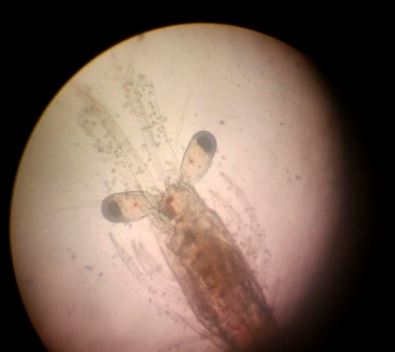
a 99.5% inhibition of Vibrio spp. (from 228,885 to 107 CFU/mL), and the clearance of Epistylis spp.,
as determined via optical microscope. These enhancements directly translated to superior biological
outcomes, with the FLOC + O group exhibiting an 82% survival rate (vs. 40% in CW) and 13% higher
final body weight (11.65 mg vs. 10.32 mg in CW). The integration of ozone and BFT also accelerated
larval development and improved the Zoea II to Mysis I metamorphosis success rate. By maintaining
stable microbial communities and reducing organic waste, the combined system lowered the water
exchange frequency by 40% and eliminated the need for prophylactic antibiotics. These results
demonstrate that ozone–BFT integration effectively addresses key challenges in shrimp prenursery—
enhancing disease resistance, optimizing water conditions, and improving growth efficiency. The technology
offers a sustainable strategy for the intensive prenursery of Pacific white shrimp, balancing ecological
resilience with production scalability.