https://www.jstage.jst.go.jp/article/ecb/63/1/63_21/_pdf/-char/en
The growth of different lettuce varieties in response to the application
of ultrafine bubbles (UFB) was investigated inside
a plant factory with artificial light (PFAL). Six different types of lettuce
(greenwave, frilly, green leaf, butterhead, romaine,
and lamb lettuce) were cultivated under UFB and control treatments using
a deep flow technique (DFT) hydroponic system.
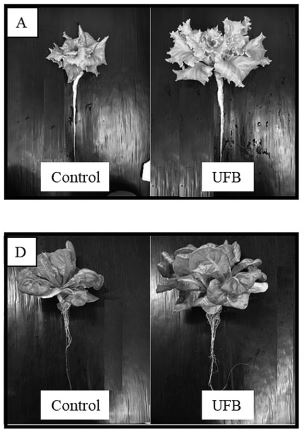
As a result, the effect of UFB treatment was found to vary depending on
the type of lettuce cultivar. UFB treatment was found
to promote growth in greenwave, frilly, and romaine lettuce but not in
green leaf, butterhead, or lamb lettuce. Compared to
the control treatment, the temperature of the nutrient solution and the
dissolved oxygen (DO) concentration were higher by
1.61 degC and 59.5% in the UFB treatment, respectively. These findings suggest
that an increased temperature and a high DO
content during UFB generation are factors that enhance lettuce growth. Taken
together, these results indicate that the
application of UFB in the DFT hydroponic culture system can significantly promote
lettuce growth in PFAL .
The promotional effects of UFB treatment in nutrient
solutions were found to be dependent on the variety of
lettuce. Among the six varieties of lettuce used in this
study, UFB treatment was observed to promote the growth
of Greenwave, Frilly, and Romaine lettuce in PFAL. The
attributes of UFB treatment, including a slight increase in
temperature and an elevation in DO levels in the nutrient
solution, were presumed to contribute to the promotional
effect of UFB. However, a comprehensive explanation of
the variation in growth response among lettuce plant varieties
to UFB application remains unclear. In addition, a previous study
suggested that the concentration of UFB in solution dictates whether
it has a promoting or suppressing effect on crop growth, depending
on the crop species (Iijima et al., 2022). Therefore, it is suggested that
not only the attribute of UFB treatment but also the differences in
endogenous ROS thresholds and growth regulator synthesis among
crop species are likely influenced by the presence of UFB in nutrient solutions.
Consequently, these variations contribute to the differing growth responses of
various lettuce species to UFB application in nutrient solutions. Further experiments
will be necessary to determine the optimum UFB application for different crop
species to achieve better growth and to elucidate how UFB accelerates lettuce
growth, which are crucial for optimizing the application of UFB in PFAL